

This past week shaped up to be much busier than expected, what with reviewing audiobook files for Awakened, preparing for a relative’s birthday celebration this weekend, and keeping my left forefinger clean and bandaged to prevent a systemic infection. Exactly a week ago, I developed a mysterious abscess under my fingernail that required medical attention–I’ll spare readers the grisly details, save to say that they were no fun at all–and a course of antibiotics. Treatment successful–much to my relief. It’s nice to be able to type with ten fingers again!
Consequently, it’s only now that I’ve had enough time to write up some of my Poldark-related thoughts, although a lengthy post on Winston Graham’s novels and their influence on me ran last Tuesday over at the Casablanca Authors blog. Inevitably, my perspective is that of a reader first, though my fondness of the original 1975 series has shaped my opinions as well. Comparisons are inevitable, but in the interests of fairness, I am endeavoring to keep an open mind and give the new series every chance to win me over.
And certainly there is much to admire about it, starting with higher production values that allow for more lavish sets and location shoots. Not all the scenery in Poldark 2015 is purely Cornish–a distinction from Poldark 1975, in which cast and crew spent several weeks in Cornwall, shooting outdoor footage–but the effect is lovely, overall. (Still, I would have preferred more conversations and character interactions, and fewer shots of Ross galloping his horse along the Cliffs of Alienation or Elizabeth gazing out of windows while the Celtic theme of Romantic Longing wailed in the background.)
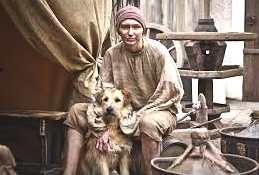
I can also commend the new Poldark‘s decision to adhere more closely to the books. Poldark 1975 was a faithful adaptation, for the most part, but significant liberties were taken at the very beginning and the very end of the series, which apparently incensed Winston Graham. So far, Poldark 2015 sticks more firmly to the plot of the first novel, and wisely introduces the major characters of Demelza Carne (the heroine) and George Warleggan (the hero’s nemesis) much sooner. Demelza’s entrance–as a ragged urchin trying to defend her beloved dog and only friend, Garrick–is particularly welcome.

While I loved the fire and spirit of Angharad Rees’s Demelza in Poldark 1975, the writing for the first few episodes conceived of the character as a saucy sex-kitten (the scriptwriters were apparently influenced by Tom Jones), which, frankly, grated at times. Fortunately, later episodes portrayed Demelza more believably as a young woman struggling to find her place in a new social order, which is also truer to Graham’s idea of the character. I have noticed that Eleanor Tomlinson, the new Demelza, has the same coloring as Rees, instead of being dark like the character is in the novels.

Any discussion of casting would have to include Aidan Turner as the hero, Ross Poldark. Robin Ellis, the originator of the role, inhabited the part so completely that the hypercritical Graham was won over, telling Ellis in an inscribed copy of Ross Poldark, “I have never seen you put a foot wrong.” It’s too early to tell whether Turner will nail the character as thoroughly, but he has potential. Certainly, he’s got the brooding, melancholy thing down pat, though he doesn’t convey the same aura of danger that Ellis did. Graham continually describes Ross as “unquiet”–and I always had the sense that an angry Ross was a powder keg that could all too easily be set off by the wrong word or action. Turner doesn’t have that combustible quality…yet. It’ll be interesting to see if he acquires it in the upcoming episdoes.

So far, my main quibbles are with the supporting characters, who presently lack the individuality they show in the novels and in the 1975 series. I’m reserving most of my judgments until I see more of them–with one exception. The new Elizabeth is a complete misfire for me. While I’m in favor of a more nuanced portrayal of this oft-maligned character, I think turning her into this nice, sweet girl who was pressured by her mother into marrying Ross’s cousin Francis strips her of her ambiguities and complexities. And on a purely physical level, I can’t accept her as a brunette either! In fact, she looks more like the books’ version of Demelza!

Graham’s Elizabeth–a cool, elegant blonde–is a much greyer figure: a well-intentioned but deeply conventional young lady who cares for Ross but who also yearns for comfort, security, and a settled existence that Ross may not be able to give her. She regrets having to hurt him but she insists that theirs was a “boy and girl attachment” and that she loves Francis as a grown woman. She is also very much a product of her time: refined, gracious, even a touch bloodless. She would never run merrily along the cliffs, her curls blowing in the wind, or ride ventre-a-terre across the moors to insist that Ross not leave Cornwall. Graham’s Elizabeth would, in fact, dearly love to leave Cornwall herself, and experience the pleasures of London, which would include having her considerable beauty admired by a wider circle of acquaintances. I suspect the changes are intended to increase Elizabeth’s likeability and thus explain Ross’s ongoing obsession with her, even as the more appealing Demelza becomes increasingly entrenched in his life. Unfortunately, in attempting to make Elizabeth more sympathetic, the new series has also made her simpler–and much less interesting.

And one more decisive thumbs-down on Ross’s famous scar. I realize that Poldark 2015 might have wanted to avoid replicating the diagonal slash across Robin Ellis’s cheek and to create a distinctive look for Aidan Turner. But given how more advanced and sophisticated make-up has become in the last 40 years, couldn’t they have come up with something that didn’t look like New Ross’s mascara was running?
Until next time!



 Blue Stockings & Crossed Genres