
“H” is for “Hearts,” plus Book Giveaway of Waltz with a Stranger

BigPinkHeart

Valentine’s Day and President’s Day fall very close together this year, so I’m about to take advantage of that fact by paying tribute to some of my favorite romantic couples in fiction in this weekend’s post.

Granted, as a voracious, lifelong reader, it’s hard for me to single out only a few. I could probably devote an entire blog to fictional couples I love and why, but I managed to narrow it down to 10 (plus 5 honorable mentions) by restricting myself to one entry per author and relying heavily on the “re-read factor.” Meaning that, whenever I pick up a book featuring this couple and start leafing through the pages, odds are very good that I’ll be hooked all over again, no matter how many times I’ve read their story before.

Ranking my favorites in order of preference, however, is a task beyond my capabilities! I love all of these couples, and their standings may be said to fluctuate on any given day. So, instead, I arranged them chronologically–in the approximate order that I first discovered them as a reader.

1. Jane Eyre and Edward Rochester (Jane Eyre by Charlotte Brontë): I discovered “frail but indomitable” Jane and her brooding hero with his mother of all dark secrets as a teen  being introduced to “the classics.” Athough, alas, no English teacher of mine ever officially put the novel on the syllabus, which is a pity because this is the ultimate Gothic romance and it ropes you in from the start and refuses to let go of you. Jane’s resilience, intelligence, and moral integrity make her an indelible heroine, and we come to care for Rochester, despite his many flaws, partly because he sincerely loves and values Jane.

2. Elizabeth Bennett and Fitzwilliam Darcy (Pride and Prejudice by Jane Austen): Another teenage discovery! I began reading P&P around the time the 1980 BBC miniseries was being broadcast in the US (and that version remains my favorite, despite the likely greater popularity of the 1995 A&E production). Elizabeth–clever, witty, and warm-hearted, though not without flaws and blind spots–is a delightful heroine, and I’ve come to appreciate Darcy more, over the years. While we aren’t privy to his POV the way we are to Elizabeth’s, he undergoes a real transformation in the book. Namely, he changes from being all about himself–his pride, his social status, his consequence, his reputation–to being all about Elizabeth and what matters to her. And this occurs after she shoots down his first proposal in no uncertain terms. Heroes who learn from their mistakes and grow in the process are heroes who deserve a second chance.

3. Demelza Carne and Ross Poldark (The Poldark Saga by Winston Graham): One summer, Masterpiece Theater was reshowing some of its most popular series, including Poldark and Poldark II, and I was spellbound, watching this sprawling saga of an 18th century Cornish mining family unfold. Naturally, I sought out the books, which are just as rewarding–and in some respects even better, because there are more of them (only the first seven novels were dramatized for TV). But the enduring love story between stormy, sardonic Ross Poldark and earthy, vibrant Demelza Carne, whom Ross rescues as a ragged urchin and later marries, is at the heart of the books and the television series. As the years pass, the Poldarks face a barrage of challenges, and usually emerge stronger and more deeply committed to each other than ever. What more can one hope for, in a romance?

4. Beatrice and Benedick (Much Ado About Nothing by William Shakespeare): Unquestionably my favorite of Shakespeare’s comedies, largely because of the perfectly matched hero and heroine. Beatrice and Benedick are both proud, brilliant, witty, loyal individuals whose “merry war” of words hints at a fascinating backstory–a possible past romance that ended in estrangement but failed to extinguish their powerful attraction and ongoing interest in each other’s affairs. When their friends conspire to make them fall in love with each other, you sense that on some level, B & B are only looking for an excuse to admit that they never stopped caring, which comes out most powerfully in a scene where Beatrice’s beloved cousin is falsely accused of being unchaste at her own wedding. Benedick’s changing sides, switching his loyalties from his male comrades to the woman he loves, is a defining moment for the character.

5. Julitta de Montrigord and Adam de Lorismond (Red Adam’s Lady by Grace Ingram): Long before the feistiest of today’s feisty heroines ever feisted, medieval heroine Julitta swung a footstool and defended her virtue from a drunk and randy Adam de Lorismond, who’d mistaken her for a tavern wench.  A sober, penitent Adam subsequently tries to make amends by marrying Julitta and striving to win her heart. The romance between these two sharply rendered characters unfolds gradually but is never less than compelling. Prickly, independent Julitta initially resents the husband she was constrained to marry, but gradually lowers her defenses as she gets to know him as more than the medieval frat boy he appeared to be.  Caught up in the Great Rebellion of 1173–in which Henry the Young King rebelled against his father, Henry II–Adam and Julitta face danger and adversity together, ultimately emerging as true partners and true lovers. Although Red Adam’s Lady has long been out of print, it is a rich and rewarding read, well worth the effort to track down.

6. Venetia Lanyon and Lord Damerel (Venetia by Georgette Heyer): Choosing one favorite Heyer is like choosing one favorite piece of Sees’ candy. But on reflection, Venetia is for me, Heyer’s most purely romantic novel, featuring a beautiful, sweet-natured heroine who is still nobody’s fool, and a cynical rake whose saving graces include a “well-informed mind and a good deal of kindness.” His sense of humor helps as well. I’m sometimes skeptical of the “Rake reformed by innocent virgin” trope, but in Venetia, it works like a charm.

7. Amelia Peabody and Radcliffe Emerson (The Amelia Peabody Mysteries by Elizabeth Peters): One of my favorite series started with a book that I thought would be a one-off: a light-hearted romantic mystery featuring a bossy Victorian spinster and an irascible archaeologist, united by their love of ancient Egypt. Instead, Crocodile on the Sandbank kicked off a long-running series about Amelia and Radcliffe Emerson, their growing family, their menagerie of exotic pets, and their yearly adventures in Egypt, excavating tombs, artifacts, and, all too often, bodies of far more recent vintage. But it’s the Emersons’ unquenchable passion for each other and their shared vocation, along with author Elizabeth Peters’ courageous decision to have the characters age and evolve, that has had me snatching up each entry when it appears.

8. Harriet Vane and Lord Peter Wimsey (Lord Peter Wimsey Mysteries by Dorothy L. Sayers): Marrying off a fictional detective is a tricky business–all too often the spouse comes off as a mere appendage, content to be a sounding board to the detective’s brilliance or, worse, a liability to be exploited by the villains seeking to defeat the detective. Harriet Vane, however, emerges as an individual in her own right: a proud, stubborn, fiercely independent woman who doesn’t suffer fools gladly. Emotionally scarred by a murder trial, she flatly refuses to play the damsel in distress to Lord Peter’s knight in shining armor. At the same time, she cannot deny her attraction to him, nor fail to notice how attuned they are, intellectually. Their off-again, on-again association reaches critical mass at Oxford, where they finally meet as equal partners in love and detection.

9. Cordelia Naismith and Aral Vorkosigan (The Vorkosigan Saga by Lois McMaster Bujold): Take a level-headed, ferociously capable surveyor-commander from a famously liberal, egalitarian planet and match her with an equally capable admiral from a militaristic, even reactionary one. Result? A love story that somehow transcends dramatically different worlds, cultures, and beliefs, and carries with it the seeds for a transformative future that neither can imagine when they first meet, a future ultimately personified by Miles Naismith Vorkosigan, the formidable son of formidable parents.

10. Philippa Somerville and Francis Crawford (The Lymond Chronicles by Dorothy Dunnett): Commander, spy, diplomat, adventurer, and overall Renaissance man, Francis Crawford of Lymond is one of the most memorable figures in historical fiction, capable of evoking extremes of love and hate. You understand why his men would follow him to the ends of the earth–and why they might also contemplate killing him when they stop for lunch. His effect on women is equally dramatic and polarizing, not least because Lymond, while possessing a healthy libido, avoids emotional commitment whenever possible. But he meets his match unexpectedly in Philippa Somerville, a Northumbrian girl who, as a child, hates and fears Lymond after he interrogates her father, but who later reevaluates her opinion of him, becomes a companion on some of his adventures, and enters into a marriage of convenience with him to protect her reputation. While separated from Lymond, who is serving Tsar Ivan the Terrible in Russia, Philippa serves at the English court of Queen Mary Tudor and grows into an accomplished, formidable young woman. Reunited with his bride, Lymond is struck by her intellect, spirit, courage, and heart–and finds himself shatteringly, overwhelmingly, terrifyingly in love for the first time in his life.

Honorable Mentions

11. Albert Campion and Amanda Fitton (The Campion Mysteries by Margery Allingham)

12. Kit Travers and Lucien Fairchild (Dancing on the Wind by Mary Jo Putney)

13. Duncan Kincaid and Gemma James (The Kincaid/James Mysteries by Deborah Crombie)

14. Annais and Sabin FitzSimon (The Falcons of Montabard by Elizabeth Chadwick)

15. Eve Dallas and Roarke (The In Death series by J. D. Robb)

Readers, who are your all-time favorite romantic couples, and why? I will be giving away a signed copy of Waltz with a Stranger to two random commenters this week.

Have a great holiday weekend!

“G” is for “Gung Hay Fat Choi”–Happy (Chinese) New Year!

800px-Ke_Lok_Si_Illuminations_01.JPGMalaysian Temple illuminated for Lunar New Year. Photo by Flying Pharmacist

As Chinese Americans, my family generally made much more of a to-do over the Lunar New Year, which could fall in either January or February. I remember bright red envelopes with a few dollars tucked inside–something every kid looked forward to receiving!; the tantalizing smells of star anise, garlic, and hoi-sin wafting from Chinese restaurants; ruddy-skinned barbecued ducks and chickens hanging from windows of Chinatown restaurants and “delis”; and the color, noise, and smoke of the lion dances.

Oh, the lion dances! When I was a little girl, I’d be beside myself with anticipation on the New Year’s weekend, knowing that we’d most likely be driving down to Chinatown to see them. (For the longest time, I thought the shaggy creatures with their huge heads and multi-colored bodies were meant to be dragons–and dragons do dance in some New Year’s festivities. But even discovering they were actually lions failed to dim the excitement.)

800px-Seattle_-_Chinese_New_Year_2011_-_71

Lion Dance Troupe in Chinatown, Seattle, Washington, 2011. Photo by Joe Mabel

A huge crowd always gathered, and it was often a challenge to find a good place to stand, especially if you were a child. But once the show started, you could count on seeing at least some of the action: the lions were pretty much in constant motion, rearing, strutting, catching the dangling offerings of money, lettuce, and mandarin oranges in their huge mouths and tossing them towards the spectators. And there were often sword dancers and drummers performing–adding even more excitement.I always brought a camera, and once, when I was about eleven, a lion dancer was especially obliging and held his position long enough for me to get an excellent shot of him, rearing the lion’s great head up to the sky.

The climax usually came, when someone lit a roll of firecrackers–thin scarlet filaments that writhed and popped like furious snakes, once ignited–and tossed them into the street. The air would turn blue with smoke, while the rapid-fire explosions reached an almost deafening crescendo. At which point, hands clapped over our ears, we’d start heading back towards wherever we’d parked the car, while the lion dance troupe moved on, to start the spectacle over in another area of Chinatown.

It’s been a while since I last saw a lion dance in person, having less tolerance for noise, crowds, and smoke than I used to. But the sight of a lion dance costume can fill me with nostalgia. Maybe someday . . .

May good fortune be yours in the Year of the Snake!

“F” is for “Far Too Many Things Under The Sun”

Hello again!

Back with a fresh Alphabet Post! Hope everyone had a wonderful holiday and New Year. Somehow, the two to three week winter break I’d planned became an almost six week-long hiatus. Time flies when you’re up to your neck in work!

I wasn’t sure what to call this particular “Alphabet Post”–because “F” can apply to so many things just now.

F is for February–a brand-new month! And it just happens to be Groundhog Day. Or Imbolc, Candlemas, Whatever You Prefer to Call It.

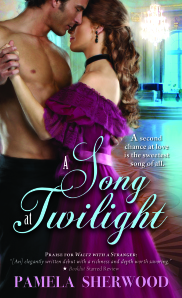
F is for Finished. Namely, the edits for A Song at Twilight, my October 2013 release, which I turned into my editor a little over a week ago. Revising is a task fraught with peril, but I do feel that the book as a whole is stronger now, especially the early part.

songattwilightcover-1

It’s a strange sensation to have that off my hands at last–liberating and lonely at once, as my mental attic is currently unoccupied. But new tenants are about to move in. Which leads me to . . .

F is for Family–specifically of the fictional persuasion. Two imaginary clans are now competing for my attention, insisting that their stories be told. I’ll be sure to let you know who wins out!

F is for Free. I spent this past week on call for jury duty–always a bit of a nuisance because you must check in every day to see if you’re needed, so it’s impossible to plan anything more than 12 hours in advance. Fortunately, my services were not required this time.

F is for Fun. I’d like to have some soon, which brings me to . . .

F is for Fred Astaire/Flying Down to Rio. One of the Christmas presents I enjoyed most was a DVD collection of Astaire/Rogers films. By this time, I’ve rewatched several of them. And while Swing Time remains my favorite, I got a kick out of watching “the good parts” version of their first film Flying Down to Rio (1933).

Flying_Down_to_Rio_Astaire_and_Rogers

Fred and Ginger are humble supporting players here, billed fourth and fifth (and Ginger comes before Fred for the only time in their collaboration), but they run away with the film, stealing it from purported leads Gene Raymond and Dolores Del Rio. (Del Rio is at least decorative, but Raymond is one of the most lumpen, unappealing leading men I’ve ever watched, and his character–a dilettante composer whose eye for the ladies frequently costs his band paying gigs–is annoying too). Fred plays “Fred Ayres” (real stretch in the names department, there!), the one who really runs the band while best pal Roger (Raymond) chases all the wrong skirts, including Brazilian beauty Belinha (Del Rio). Ginger is “Honey Hayle,” the band’s pert lead singer, who may or may not be Fred’s girlfriend. While they partner each other in a lively “Carioca,” they share no kisses (a fine romance, my friend, this is!), but are last seen getting happily sloshed together at the end of the film. Small wonder that audiences wanted more of these two!  So, while Flying Down to Rio is a mixed bag, any Fred-Ginger scenes in it are worth watching, as is the unapologetically over-the-top climactic number featuring chorus girls performing on the wings of airplanes.

So that, in a nutshell, is how I’ve been spending the last five or six weeks. Revising, creating, waiting, and watching. Now that things have calmed down, I hope to be around on this blog a bit more often.

See you around!

“E” is for “Entry”

To a different world, and a different culture.

200px-Garuda_Emblem_of_Thailand.svg

Last week was an experience for me. But not just because Waltz with a Stranger was finally released. On December 5, I was one of a small party that attended a reception in honor of the King of Thailand’s birthday, held at a local country club. (A relative teaches the general consul’s son, and unexpectedly received an invitation. The rest of us came along as moral support.)

So there we were, all dressed up for the evening–can’t go wrong with a little black dress and a sparkly necklace!–and getting an on-the-fly lesson in Thailand’s political history, an eyeful of Thai traditions, and later on, generous servings of Thai food (tasty, but definitely on the “hot” side. I regretted the apparent absence of Thai iced tea to cool things down, afterwards.) There was a great deal to see, hear, and absorb–much of which I’m still reflecting on–but here are some thoughts/discoveries to start with.

800px-Thai_Village_-_Dinner

Massaman Curry, photo by Ernesto Andrade

Bhumibol Adulyadej, also known as Rama IX, has ruled Thailand for 65 years, and is still a popular, much revered figure in his country. As a citizen of a nation in which we “fire” our head of government every four years if we’re dissatisfied with his policies and see a changing of the guard every eight years whatever the outcome, I found myself amazed by the thought of any one person being in power for six and a half decades. And then remembered Queen Victoria and her own 64 years on the English throne, and the reverence she most often inspired in her subjects, even those who were critical of her. The British and the Thais were both fortunate to have monarchs who appeared to have their country’s best interests at heart.

It was intriguing to hear how invested the Thais were in the outcome of our own recent election. One of the speakers of the evening proposed a toast to President Obama, in honor of his second term, and mentioned that the president had made a recent visit to Thailand after winning reelection. He voiced the hope that Thailand and the U.S. would continue their friendly relationship of many years.

800px-Rama_IX_of_Thailand_and_Barack_Obama

Meeting of President Obama and Rama IX, 11/18/12

Back in the club, monitors showed news footage of Bhumibol’s past visits to the United States. A placard displayed an excerpt of a speech he gave on one such visit.

On lighter subjects: Thai national dress is stunningly beautiful. We saw a number of Thai women, many exquisitely gowned in silks and satins, lovely sheeny fabrics heavy with embroidery or crusted with gems.

800px-Thai_girls_in_traditional_costumes_Chiang_Mai_2005_032

Thai girls in traditional costume. Photo: Yashi Wong

Thai culture seems to place a high value on beauty in general. On the terrace where the reception was held, there were corners in which guests could see popular Thai pastimes at work: garland-making–jasmine is a staple, because of its perfume; fruit and vegetable carving, into beautiful, elaborate shapes; and calligraphy (I now have a bookmark with my name written in Thai).

450px-Krip.JPG

Carved carrot and cucumber. Photo: Mattes

Throughout the evening, we glimpsed some traditional Thai dances–“glimpsed” because the terrace was very crowded and visibility at something of a premium. I marveled at the sight of the dancers in their elaborate headdresses, which I hoped were lighter than they appeared. And a small group of musicians played throughout the evening. I noticed a cello, a hammer dulcimer, something that looked like a large xylophone, and a thoroughly modern electronic keyboard! Or perhaps it was a synthesizer–I never plucked up the nerve to ask.

800px-Khon_Dance_Frankfurt_Germany_2006

Khon Dancers in Performance

But, in the midst of all this fascinating history and culture, perhaps the most novel experience of the evening for me . . . was finding myself, at a mere 5′ 4″, among the taller people at the party. An evening to remember indeed!

“D” is for “Dance”: Waltz with a Stranger is Here + Giveaway!

291px-Pierre-Auguste_Renoir_019

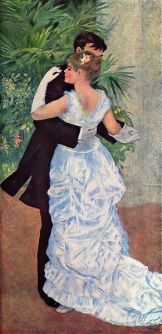
Dance in the City, Pierre-Auguste Renoir

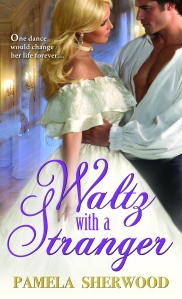
Fourteen months after accepting my publisher’s offer, I am delighted to announce the arrival of Waltz with a Stranger on December 4, 2012. It’s been a long journey, and one that I couldn’t have made without the support and encouragement from so many people in both my personal and professional life, from my family and friends to my agent, my editor, and the whole team at Sourcebooks. Thank you all for helping me to realize my dream! And more stories will be coming (I hope!).

In honor of Release Day, I will be giving away two copies–signed, if you like–of the actual book (not an ARC!) to commenters below. And this month, I will also be embarking on a “virtual tour,” visiting various blogs and websites to discuss and promote Waltz with a Stranger. Tour dates and locations are listed and linked on the News page of Blue Stockings & Crossed Genres, if you’d like to drop by and say hello while I’m “on the road.”

A few words on the subject of “the dance,” as this is also an “alphabet post.”

It was through Fred Astaire, Ginger Rogers, and a double feature of Swing Time and Top Hat that I first learned about dance as “the language of love.” Granted, I was only eight or nine at the time, but the romance, grace, and artistry of one of Hollywood’s best dance teams made a permanent impression.

That impression was reinforced and given a slightly racier spin some years later when my graduate school roommate–a fellow Astaire-Rogers fan–and I were watching The Gay Divorcée on TV. We watched spellbound as the duo spun and glided through the number “Night and Day” with their trademark flair. After which, Fred leaned over a breathless, wide-eyed Ginger, and asked in a low, intimate voice: “Cigarette?” To which she could only shake her head in response.

My roommate and I stared at each other, absorbing what we’d just seen and heard . . . and then we burst into shrieks of laughter at how adroitly the film makers had managed to circumvent the Hays code!

318px-Pierre-Auguste_Renoir_146

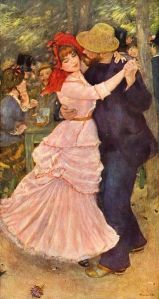
Dance at Bougival, Pierre-Auguste Renoir

While James and Aurelia, the hero and heroine of Waltz with a Stranger, are not in the same terpsichorean league as Fred and Ginger, they nonetheless share a special connection when they dance. A connection that–as with Fred & Ginger in their many films–transcends speech and carries with it the whisper of secret longing and forbidden love. A connection that ultimately proves impossible to deny . . .

Waltz Cover 2

So, if you like the sound of this, please save a place on your dance card for Waltz with a Stranger!

Edited To Add: The hat of destiny has decreed that Rebecca Burnham and infinitieh are the recipients of this week’s giveaway of Waltz with a Stranger. Please contact me with your mailing addresses so I can send your copies (signed if you’d like) to you as soon as possible.