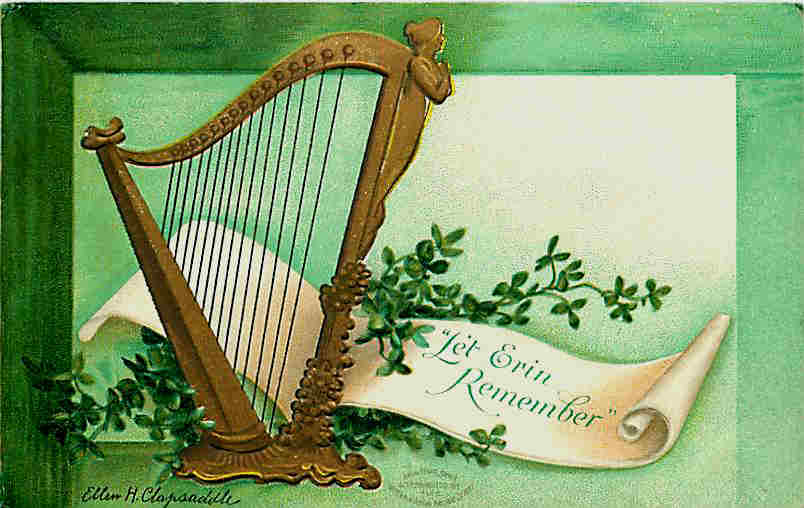
The minstrel boy to the war is gone, In the ranks of death you’ll find him; His father’s sword he has girded on, And his wild harp slung behind him; “Land of Song!” cried the warrior bard, “Though all the world betrays thee, One sword, at least, thy rights shall guard, One faithful harp shall praise thee!”
The Minstrel fell! But the foeman’s chain Could not bring his proud soul under; The harp he loved ne’er spoke again, For he tore its chords asunder; And said “No chains shall sully thee, Thou soul of love and bravery! Thy songs were made for the pure and free They shall never sound in slavery!”
Come this Sunday, I will most likely be the grouchiest grouch that ever grouched–for reasons that I explained in some detail last year. Rather than rehash my eternal grudge against Daylight Savings Time, I decided to accentuate the positive and share a bit from my current WIP, tentatively titled Devices and Desires.
Recently I took a stab at writing some BCC (Back Cover Copy), a task that seems to devolve more frequently on the author these days. (Not that I’m complaining–having read some truly baffling publisher-generated BCC in my time, I suspect authors do a better or at least more accurate job of it!)
A Little Less than Kin . . .
From childhood, Lady Margaret Carlisle’s life has been entwined with the rich, powerful, and contentious Lyons family, until her intended’s untimely death five years ago. Now a widow, she finds herself drawn into their intrigues once more . . . and unexpectedly tempted by a brilliant, lonely man, whose friendship she has long taken for granted.
And More than Kind . . .
They call him the Clockwork Solicitor, the perfect lawyerly device. But Lord Gervase Lyons’ icy demeanor conceals a lifetime of emotional scars–and an undying passion for the one woman he can never have. Summoned to his family’s Christmas gathering, where old wounds will be reopened, old quarrels revisited, and old secrets revealed, Gervase receives the chance to win her heart at last.
Excerpt
(In this scene, the hero and heroine–aged 16 and 14, respectively–come together to help his 8-year-old sister during a pet-related crisis)
“Mr. Scorton’s horrid mastiff chased Xerxes up a tree, and he won’t come down! Please, Gerry, you’ve got to help–he could be stuck up there forever!”
Gervase had closed his book with a martyred air, accompanied by a put-upon sigh. “Ju, didn’t Mother tell you to leave the little beast at home? He hasn’t the sense to fend for himself out here.”
“I–I forgot,” Juliana faltered, flushing.
“How convenient,” Gervase observed dryly. Then he looked at his sister, gazing up at him with tear-drenched blue eyes . . . and weakened, visibly. “Oh, very well, brat. I’ll see what I can do. But I’m not risking my new jacket for that wretched bit of fleabait. Which tree was it?”
Juliana, to her credit, did not so much as bristle at this slur on her beloved pet. “One of the trees we picnicked under,” she sniffed, swiping at her eyes.
Margaret surprised herself by coming forward. “Can I help?” she asked.
“How are you at climbing trees?” Gervase inquired.
“Not so good,” she admitted. “At least, not while I’m wearing a dress. But if you need an extra pair of hands . . .”
“All right” he conceded. “Come on, Ju–take us to the tree.”
Minutes later, they stood at the foot of an ash tree, looking up into the leaves. A scrap of ginger fur clung to one of the higher branches, mewing pitifully.
Gervase considered the kitten for a moment, then turned towards the blanket still spread out upon the grass. Shrugging off his jacket, he rummaged through the picnic hamper, emerging with one of the finger sandwiches. “Fish paste,” he explained, and returned to the tree.
“You’ll need both hands for climbing,” Margaret warned him.
“I’m aware of that.” He glanced at the sandwich, gave another forbearing sigh, and gingerly tucked it into the cuff of his left sleeve before starting his ascent.
“Will the branches bear your weight?” Margaret called anxiously as he shinned up the trunk. Agile and lightly built as he was, he should climb more easily than Hal or Reg, but still . . .
Gervase glanced down, his expression slightly pained. “I’ll find out soon enough, won’t I?” he remarked, and reached for the nearest bough.
Strangely breathless, Margaret and Juliana watched him climb, a slim figure moving from branch to branch, a fish paste sandwich peeking incongruously over his left shirt cuff. Up he went, balancing carefully. Once his foot slipped, and Margaret thought she heard him mutter a curse as he strove to regain his balance, then adjusted his position, set his foot on a different branch and resumed his climb.
Finally, boy and cat were face to face, with barely a foot of distance between them. Gervase clicked his tongue, and held out the sandwich just within reach. “Come along, then.”
The words were brisk rather than coaxing, but his tone was low and gentle enough. Margaret could just imagine the kitten’s whiskers twitching at the smell of the fish paste. He gave another plaintive mew, scarcely more than a squeak, stretching out an imperious little paw.
Gervase leaned in, extending the sandwich further, and Xerxes inched closer. And closer . . . until he was just within reach. Quick as a flash, Gervase tugged the kitten free of the branch, and pulled him close to his shirtfront as he began to climb down. He moved cautiously, not rushing his descent, but Margaret wasn’t sure she breathed until he was on the ground again.
“Here you are, brat.” Gervase held out the kitten and the by now half-eaten sandwich to his sister. “Now for pity’s sake, take him home, and don’t let him out until he’s bigger and has more sense than a dandelion puff!”
Juliana, eyes shining, kissed her brother on the cheek and ran off, the kitten still clutched in her embrace.
“Little pest,” Gervase observed.
Margaret couldn’t tell whether he meant Juliana or the kitten. But when he reached up to push back his hair, she caught sight of something more alarming, “Gervase, you’re bleeding!”
“Ah.” He pulled his hand back, glanced at the drops of red welling on his forefinger and thumb. “Little beast managed to get a claw into me, after all.”
“Here.” Margaret fished out her handkerchief–clean, thankfully–and wrapped it carefully around the affected digits. “Juliana will be everlastingly grateful.”
“Well, she’d better be,” he retorted. “It’s not every brother who’ll risk life, limb, and wardrobe retrieving some dim-witted cat. I must have looked a proper charley trying to coax him down.” He pulled a face. “And my shirt now smells of fish paste, though it had to be laundered in any case, so no harm done, I suppose.”
“I thought . . . I thought you were rather splendid, actually,” Margaret confessed.
He stilled, his grey eyes flaring wide. “Good Lord, was that a compliment? From you?”
Margaret felt herself flush. “I pay them–now and then,” she said, a touch primly. “When someone deserves it.”
His mouth quirked up and she caught the unexpected flicker of a dimple. “Lady, I shall study deserving,” he misquoted, and swept her a mock bow.
* * *
Hope you enjoyed this glimpse into WIP-land! And may you weather the time change smoothly and successfully.
As I type this, March is fulfilling its proverbial role of coming in like a lion. Just a few minutes ago, all that I could hear was the roar of water descending from the sky, like the flow from an Eternal Faucet (or Showerhead). It’s subsided a little by now, but I can still hear it, trickling from the eaves, beating its way into the still-damp ground. The raindrops sound like tiny hammer blows as they strike the earth.
We need this rain badly, of course. Southern California’s had one of its dryest years yet, and there have been some nasty brush-fires recently–one of which was caused by a trio of careless idiots who decided to light an illegal campfire while they were out in the hills one night. Alcohol and pot may have also been involved, which doesn’t surprise me a bit. I could wish, though, that we weren’t getting this rain in a lump, increasing the risks of mudslides, flash floods, and road accidents.
Still, compared to snow-besieged friends and family in the East, we’re probably getting off lightly. And when I’m not actually caught in the rain, fighting the wind and wet as I try to get from Point A to Point B (as I was on one notable occasion last summer), I find it evocative, and sometimes even soothing.
If you can avoid going anywhere during a rainstorm, I advise you to do so. Curl up with a good book or a favorite movie. Press on with that troublesome scene you’ve been writing. Cook something that makes the house smell wonderful. Catch up on some correspondence. Listen to that album you’d been meaning to play. Take advantage of Nature’s little tantrum and treat yourself to some entertainment indoors, especially if you’re lucky enough to still have electricity!
The unknown author of the 16th century poem I quoted in the title of this blog may have had the best idea yet:
O, western wind, when wilt thou blow?
The small rain down can rain.
Christ, that my love were in my arms,
And I in my bed again!
As rainy day activities go, that has a distinct appeal!
My name is Pamela, and I’m a figure skating junkie. Or used to be.
Babilonia & Gardner in 1979, photo by Tony Duffy
I first started taking notice of the sport at the 1980 Winter Olympics at Lake Placid, when pairs skaters and reigning world champions Tai Babilonia and Randy Gardner were forced to withdraw from competition because of his groin injury. Disappointing as that was to see (and devastating for B&G themselves), I ended up sticking around for the other disciplines. My most vivid memory after their withdrawal was watching lean, elegant Robin Cousins–one of the tallest men in the sport–win the men’s gold for Great Britain, and two young American up-and-comers David Santee and Scott Hamilton place fourth and fifth. And just like that, I was hooked.
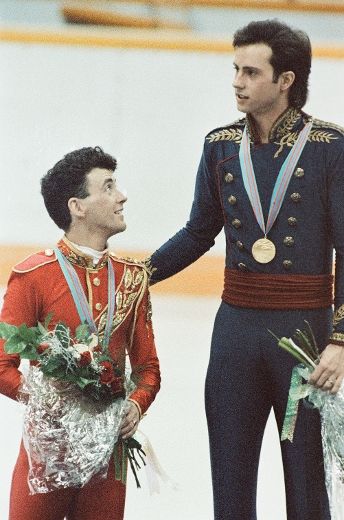
The Brians on the Olympic podium, photo by Calgary Sun
I followed the sport faithfully after that, watching Hamilton fulfill his early promise with four world championships and a gold medal in Sarajevo, 1984. After that, I watched two amazingly talented, closely matched male skaters–one American, one Canadian, both named Brian–vie for dominance in the sport over the next four years, a competition finally resolved by a narrow victory for the American Brian [Boitano] over the Canadian Brian [Orser] at the 1988 Olympics in Calgary. (By the way, “Battle of the Brians” = “Best Skating Rivalry Ever”). And I was thrilled when perennial long shot Paul Wylie won a silver medal at the Albertville Games in 1992, skating beautifully to a program set to Patrick Doyle’s “Henry V,” one of my all-time favorite soundtracks.
The women’s competition provided its share of memorable moments and unforgettable skaters over several Olympiads too. Elaine Zayak finished off the podium but not before upping the technical level for the sport by performing multiple triple jumps. Katarina Witt became the first woman since Sonja Henie to win back-to-back gold medals in 1984 and 1988. Debi Thomas became the first black woman to win a world championship and earned an Olympic bronze in 1988. And Canadian Liz Manley stole both Witt and Thomas’s thunder by winning the long program (and a silver medal) at the Calgary Games–skating to music that was not from “Carmen.”
Michelle Kwan, in Lyrica Angelica
The 1992 Games swept Kristi Yamaguchi (gold) and Nancy Kerrigan (bronze) to fame, then two years later, all hell broke loose with an attack on Kerrigan (front-runner for the gold at Lillehammer) orchestrated by the ex-husband of her U.S. rival Tonya Harding. The fallout from that ugly incident lasted for years, but fortunately, a fresh crop of skaters, led by the phenomenal Michelle Kwan, took away some of the lingering bad taste. Ultimately, Olympic gold was not in the stars for Kwan, and I winced every time it slipped away from her. But nine national titles, five world titles, and Olympic silver and bronze medals still represent one hell of a legacy, and she’s rightly considered one of the all-time greats.
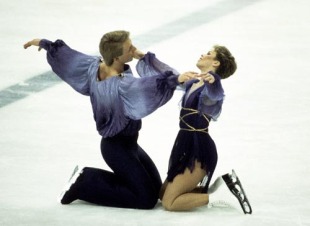
Pairs and ice-dancing weren’t on my radar to the same degree as the singles events. But I watched slack-jawed with the rest of the world when Torvill and Dean essentially revolutionized ice-dancing with “Bolero” in 1984. And scratched my head over some of the routines that emerged in the post-T&D era. More than the other disciplines, ice dancing seems prone to frequent reinvention–the pendulum is constantly swinging, though you can’t always predict in which direction!
Torvill & Dean in Bolero, 1984, photo by Getty Images
Over the last decade or so, my interest in figure skating has waned, mostly due to decreased coverage of the sport, an increasingly incomprehensible scoring/judging system, and the relative lack of strong skaters to emerge from the ranks, once the “veterans” retire or turn pro. But in spite of all that, once that Olympic torch is lit and the ice rink properly Zambonied, I’m there again–ready to marvel at the skaters’ ability and tenacity, laugh at the sillier costumes and programs, question the judges’ sanity, and applaud or criticize the results.
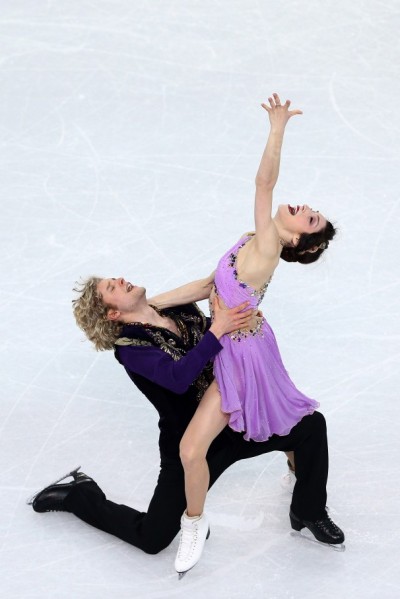
And the Sochi Games of 2014 provided plenty of the above. From the introduction of the new team competition, to the resurgence of the Russian pairs skaters, to the cringe-inducing splat-fest that was the men’s free skate, to the well-deserved Olympic coronation of ice dancing favorites Davis and White, to the highly controversial outcome of the women’s competition, figure skating once again provided two weeks of fascinating, on-the-edge-of-your-seat drama.
Davis & White in free dance, photo by Clive Mason/Getty Images
Tonight, after “16 Days of Glory,” the Olympic torch goes out. See you in four years!
St. Valentine Baptizing St. Lucilia, by Jacopo Bassano (1510-1592)
AN EPITHALAMION, OR MARRIAGE SONG ON THE LADY ELIZABETH AND COUNT PALATINE BEING MARRIED ON ST. VALENTINE’S DAY
I
HAIL Bishop Valentine, whose day this is ; All the air is thy diocese, And all the chirping choristers And other birds are thy parishioners ; Thou marriest every year The lyric lark, and the grave whispering dove, The sparrow that neglects his life for love, The household bird with the red stomacher ; Thou makest the blackbird speed as soon, As doth the goldfinch, or the halcyon ; The husband cock looks out, and straight is sped, And meets his wife, which brings her feather-bed. This day more cheerfully than ever shine ; This day, which might enflame thyself, old Valentine.
II.
Till now, thou warmd’st with multiplying loves Two larks, two sparrows, or two doves ; All that is nothing unto this ; For thou this day couplest two phoenixes ; Thou makst a taper see What the sun never saw, and what the ark —Which was of fowls and beasts the cage and park— Did not contain, one bed contains, through thee ; Two phoenixes, whose joined breasts Are unto one another mutual nests, Where motion kindles such fires as shall give Young phoenixes, and yet the old shall live ; Whose love and courage never shall decline, But make the whole year through, thy day, O Valentine.
III.
Up then, fair phoenix bride, frustrate the sun ; Thyself from thine affection Takest warmth enough, and from thine eye All lesser birds will take their jollity. Up, up, fair bride, and call Thy stars from out their several boxes, take Thy rubies, pearls, and diamonds forth, and make Thyself a constellation of them all ; And by their blazing signify That a great princess falls, but doth not die. Be thou a new star, that to us portends Ends of much wonder ; and be thou those ends. Since thou dost this day in new glory shine, May all men date records from this day, Valentine.
IV.
Come forth, come forth, and as one glorious flame Meeting another grows the same, So meet thy Frederick, and so To an inseparable union go, Since separation Falls not on such things as are infinite, Nor things, which are but one, can disunite. You’re twice inseparable, great, and one ; Go then to where the bishop stays, To make you one, his way, which divers ways Must be effected ; and when all is past, And that you’re one, by hearts and hands made fast, You two have one way left, yourselves to entwine, Besides this bishop’s knot, of Bishop Valentine.
V.
But O, what ails the sun, that here he stays, Longer to-day than other days ? Stays he new light from these to get ? And finding here such stars, is loth to set ? And why do you two walk, So slowly paced in this procession ? Is all your care but to be look’d upon, And be to others spectacle, and talk ? The feast with gluttonous delays Is eaten, and too long their meat they praise ; The masquers come late, and I think, will stay, Like fairies, till the cock crow them away. Alas ! did not antiquity assign A night as well as day, to thee, old Valentine ?
VI.
They did, and night is come ; and yet we see Formalities retarding thee. What mean these ladies, which—as though They were to take a clock in pieces—go So nicely about the bride ? A bride, before a “ Good-night” could be said, Should vanish from her clothes into her bed, As souls from bodies steal, and are not spied. But now she’s laid ; what though she be ? Yet there are more delays, for where is he ? He comes and passeth through sphere after sphere ; First her sheets, then her arms, then anywhere. Let not this day, then, but this night be thine ; Thy day was but the eve to this, O Valentine.
VII.
Here lies a she sun, and a he moon there ; She gives the best light to his sphere ; Or each is both, and all, and so They unto one another nothing owe ; And yet they do, but are So just and rich in that coin which they pay, That neither would, nor needs forbear, nor stay ; Neither desires to be spared nor to spare. They quickly pay their debt, and then Take no acquittances, but pay again ; They pay, they give, they lend, and so let fall No such occasion to be liberal. More truth, more courage in these two do shine, Than all thy turtles have and sparrows, Valentine.
VIII.
And by this act these two phoenixes Nature again restorèd is ; For since these two are two no more, There’s but one phoenix still, as was before. Rest now at last, and we— As satyrs watch the sun’s uprise—will stay Waiting when your eyes opened let out day, Only desired because your face we see. Others near you shall whispering speak, And wagers lay, at which side day will break, And win by observing, then, whose hand it is That opens first a curtain, hers or his : This will be tried to-morrow after nine, Till which hour, we thy day enlarge, O Valentine.
 The Minstrel Boy




 Blue Stockings & Crossed Genres