Leave it to Edgar Allan Poe to write a poem about the Ultimate Haunted House!
The Haunted Palace
In the greenest of our valleys By good angels tenanted, Once a fair and stately palace— Radiant palace—reared its head. In the monarch Thought’s dominion— It stood there! Never seraph spread a pinion Over fabric half so fair!
Banners yellow, glorious, golden, On its roof did float and flow, (This—all this—was in the olden Time long ago), And every gentle air that dallied, In that sweet day, Along the ramparts plumed and pallid, A winged odor went away.
Wanderers in that happy valley, Through two luminous windows, saw Spirits moving musically, To a lute’s well-tunëd law, Bound about a throne where, sitting (Porphyrogene!) In state his glory well befitting, The ruler of the realm was seen.
And all with pearl and ruby glowing Was the fair palace door, Through which came flowing, flowing, flowing, And sparkling evermore, A troop of Echoes, whose sweet duty Was but to sing, In voices of surpassing beauty, The wit and wisdom of their king.
But evil things, in robes of sorrow, Assailed the monarch’s high estate. (Ah, let us mourn!—for never morrow Shall dawn upon him desolate !) And round about his home the glory That blushed and bloomed, Is but a dim-remembered story Of the old time entombed.
And travellers, now, within that valley, Through the red-litten windows see Vast forms, that move fantastically To a discordant melody, While, like a ghastly rapid river, Through the pale door A hideous throng rush out forever And laugh—but smile no more.
It’s Columbus Day–and the release date of my e-novella, A Wedding in Cornwall!
Robin and Sophie, the star-crossed hero and heroine of A Song At Twilight, are finally getting married. Join them and their families as they celebrate this happy, long-awaited, and long-overdue occasion. But expect a few surprises on the road to Happy Ever After…
The Story Behind the Story: To someone who loves words as much as I do and who tends to the naturally verbose <G>, writing shorter lengths tends to be a challenge. My short stories want to turn into novellas, my novellas into novels, and my novels into sagas! I admire and envy writers who can turn out those neat-but-complete packages of 20-40K words that can supplement their longer works or provide just the right amount of zing for the stressful holiday season, like a perfect amuse-bouche between dinner courses.
But in this year of Trying New Things, I was determined to get the hang of it. For some time, I’d been toying with the idea of writing about Sophie and Robin’s wedding, though, at first, I wasn’t sure there was enough material for more than a very short story. Then another subplot idling at the back of my mind–concerning Sophie’s brother Harry and the woman he’d been carrying on with for the last few years–sprang to the forefront and attached itself to the wedding story, and suddenly I had a burgeoning novella on my hands. Even better, I had a solid narrative structure to follow from start to finish (this does not always happen, so cherish the times when it does!).
A Wedding In Cornwall was completed in just a little under two months (that, too, was rare for me, and thus, worth celebrating). Serendipitously, I found a very pretty pre-made cover on BookGraphics.net that was a good fit for the story’s romantic spirit. L.K. Campbell, who formatted my fairy tale collection last spring, was available to perform the same service for A Wedding in Cornwall. So, within a fairly short time, the novella was ready to go, and I was mulling a mid-September release.
At which point, my old computer gave up the ghost, necessitating a data transfer and a replacement/upgrade of my whole set-up. Fortunately, everything was recoverable, and I’m in the habit of sending my most important projects to my email cache anyway, so disaster was averted. Just. Have I mentioned lately that September is not my favorite month? This one was particularly trying.
October, however, feels more auspicious, so I chose a date that I’d have no trouble remembering. And voila! A Wedding in Cornwall is now available for a special promotional price of .99 (for a limited time), on the following platforms:
It’s the sound no Mac user ever wants to hear when she presses the Power button.
Dead silence.
To be followed by escalating panic and repeated efforts to reboot by painstakingly disconnecting and then reconnecting all the cables before powering up again, step by step. To no avail.
To be followed by a pilgrimage to the closest Mac serviceperson, who also fails to revive your silent machine and regretfully informs you that the cost of repair would be more than the computer is currently worth.
At which point, you grit your teeth, approve the retrieval and transfer of your files to an external drive, wincing at the cost, and then, still wincing, set out to replace your venerable desktop with something more up to date.
Which is the position I found myself in about three weeks ago. Fortunately, the process of getting everything set up and running again was easier than expected–if not entirely painless. Best of all, my data appears to be intact, which was my main concern.
My computer crisis was just one in a string of difficulties last month, most of which revolved around Broken Stuff. I’m crossing my fingers that October will be easier in that respect, at least!
On the up side, I can make the announcement that, barring further disaster (knocking repeatedly on wood), A Wedding In Cornwall–my companion novella to A Song At Twilight–will be released this month! I had a lot of fun revisiting Cornwall and writing about Sophie and Robin’s big day, as well as offering a hint about what lies in store for other characters.
Plus, I’m including a sneak preview of my next series, The Lyons Pride, about a contentious ducal family–inspired by an even more contentious royal family–and their efforts to find love, healing, and lasting happiness!
For more information on future works, just watch this space. Or sign up for my new release letter, over at this website’s sidebar.
Hoping that autumn brings good times and good reads to all of you!
All right–that had to be two of the strangest hours I’ve ever watched! Some of the closest fidelity to the original source material–right down to the dialogue–juxtaposed with departures from canon that were almost Twilight-Zone levels of Bizarre.
So, just as the Poldarks of Nampara experienced a reversal of fortune, so is this week’s commentary experiencing a reversal of sequence.
The Wreck of the Edwin Fitz–oops, Queen Charlotte!
The WTF?
*Who knew that 18th century Cornwall was so technologically advanced that the Warleggans could receive breaking news reports of a shipwreck at least ten miles away, at night, in a howling gale? Must have been their cutting-edge social media outlets–no, wait, not invented until the 21st century. Their telegraph system–no, not invented until the 19th century. Their semaphore system–no, not invented until 1792, in France. The Pony Express—whoops, wrong century and wrong continent! Seriously weird–the earliest George and Cary could have found out about the wreck would have been the following morning. Unless the series was trying to imply it was flashing forward from the wreck to the Warleggans learning about it? In which case, the writers should have made it clearer to the viewer. Moreover, if the Warleggans were receiving such up-to-the-minute bulletins on the wreck, who was on the spot to write them up and/or deliver them? And why was there no sense of urgency once they received that news? Instead of springing into action and rousing the militia to rescue passengers (including their own cousin) and reclaim cargo, they sit around—at night, when business is over and most folks are abed—sipping brandy, speculating about Ross’s involvement, and passively awaiting further news with all the immediacy of guys anticipating texts and tweets on their cell phones.
*Mystified as well by the elimination of Ross’s more heroic actions during the wreck. While he does alert the starving community to the cargo coming ashore and doesn’t stop them carrying off the lot, he also takes a line and goes into the water to look for survivors. Sanson is found dead, floating face down in the remains of a ship’s cabin. All of Ross’s actions that night–the commendable and the morally ambiguous–play a major role in his upcoming trial, and the former is important because it’s a mitigating factor in the charges against him.
*George’s Inappropriate Advance: Francis, Elizabeth, and Geoffrey Charles all survive a life-threatening illness, but this is the time for George to ooze over to Trenwith to declare his “intentions” towards Elizabeth? Back the mine cart up, buster! Her husband’s still alive and could live another 30 or 40 years for all you know. If George was insinuating that he meant to make a play for Elizabeth despite her married status, she’d have been well within her rights to slap his face and throw him out of the house, because the most likely interpretation of his remark would have been that he wanted to make her his mistress. And while I don’t hold with the saintly Elizabeth this show is trying to sell me, I do acknowledge that she is virtuous and chaste by the standards of her time. She may be disappointed in Francis, but she wouldn’t cheat on him, least of all with George whom they (erroneously) believe is their BFF. Graham’s George played his infatuation with Elizabeth closer to the vest, so he could keep on seeing her. Plus, he used the perfectly legitimate excuse of being Geoffrey Charles’s godfather to call frequently, bring gifts, and ingratiate himself with Elizabeth in that way. He was certainly never this indiscreet.
*Talking of indiscretion, Ross was pretty shortsighted, even stupid, not to have safeguarded the names of his fellow shareholders better. “I’m going to sit here with my Carnmore paperwork in a public place, so anyone who looks over my shoulder or sits across from me can get a nice clear look at the names of all my partners in this Top Secret Venture.” In the books, Ross entrusts a list of his partners’ names to Pascoe, who promptly locks it in a safe. Ross realizes that only Francis could have betrayed him because he was the one who knew who was present when the Carnmore Copper Company was first formed. To be honest, I was also underwhelmed by much of Turner’s performance last night. He seemed to be in a fugue state most of the time, delivering his lines in this morose monotone that never varied. That worked for the scenes surrounding Demelza and Julia’s bout with diphtheria (the official name of the “putrid throat”) and the wreck, but not so well when he was dealing with his business failure and Demelza’s betrayal of his trust. I wanted to see a more active anger, even some outrage or passion, rather than this ongoing low-voiced sullenness. A little variation in vocal inflection or facial expression would have been welcome.
Sympathy from the Devil?
The Bad
*Francis was even more pathetic than usual. In the book, he betrays Ross in a moment of white-hot rage over Verity’s elopement–you can believe it’s something he might regret later after he cools down (which proves to be the case in Book 3). Here, he sings like a canary after George plies him with liquor and plays him like a fiddle. He seems more peevish than furious when he offers up the names of Ross’s partners, and the lack of any real sense of closeness or affection between Francis and Verity doesn’t help. Like their father, Francis appears to want her to continue to be the spinster prop and unpaid drudge in the household, while Verity seethes with unspoken resentment whenever she looks at Francis. In the books, she was the older sister and surrogate mother (Charles’s wife died young), and he was her baby brother, making it easier to understand his dependence on her and her reluctance to leave him when the family fortunes decline.
*Spare me from more of St. Elizabeth. Graham’s Elizabeth never sympathized or sided with Verity’s elopement; in fact, she was most put out when Verity left. Nor does she visit Nampara to return Demelza’s favor of nursing her through the illness. This is not to say she wouldn’t have tried to show some kindness by sending things like restorative broths, home remedies, and possibly a servant to help out, along with a letter of condolence. I can easily imagine her doing that, though that doesn’t happen in the novel either. But given how debilitating the illness was, the Trenwith Poldarks wouldn’t have been in any shape to drag their sick butts out of bed to attend Julia’s funeral or call on bereaved Ross and his mortally ill wife in the dead of winter.
*I don’t believe for a single second that George would give a damn about Ross’s child dying. Or that he was ever truly interested in Ross’s friendship, except as a means to an end. Plus, this George is such a pretty-boy fop, more posh even than the gentry, that his supposed insecurity about his family’s origins fails to ring true. His solicitude is as phony as his curls.
*Am I the only one disturbed by the way this series seems to be making women complicit in their own murders by their drunken or jealous husbands? Keren was depicted as a cheap little slut here, but Book-Keren didn’t attack Mark physically in their last confrontation and he didn’t kill her while trying to defend himself. It was murder, though committed in the heat of the moment, not premeditated. Graham didn’t soften the edges in Mark’s situation any more than he did in Blamey’s. The whole “She attacked first” argument here squicks me out.
*As I feared, having an older Dwight made his succumbing to Keren’s crude seduction attempts much more stupid. I did notice that this series implies that it was a one-night stand, rather than the ongoing affair it is in the novel—doubtless to minimize Dwight’s indiscretion. At least he was seen actually practicing medicine, for a change.
*Firing the Paynters. This is a much more explosive occurrence in the book, with a drunken Jud becoming violent, breaking crockery, getting into a physical scuffle with Prudie, and scaring the babies. Also, Demelza was not in the house at the time, but Jinny was, and Jud’s unfounded accusation about Ross fathering her child upsets her terribly. This series treated the whole sequence perfunctorily and with much less detail and depth. Plus, this Jud is always such a nasty, mean character, drunk or sober, that it’s hard to understand why what he says this time is so much worse than what he says at any other.
For Better or For Worse
The Good
So, what did I like?
*Ross and Demelza working as a team to spirit Mark away. When things are right between them, they are impressively, even wonderfully in sync. Demelza continues to grow into herself and prove that she’s the quick-witted, capable partner Ross probably never knew he needed or wanted.
*The introduction of Captain MacNeil has potential—he’s a worthy but not evil adversary of Ross in the books—though what’s with making him also another ex-army friend of Ross’s? That’s neither accurate nor necessary, any more than changing Dwight’s backstory was.
*Verity finally making a bid for her own happiness. The payoff was sweet, and the moment of her boarding Blamey’s ship in the end was very reminiscent of the 1995 film version of Persuasion, when Anne shows that she is going to be fully involved in Wentworth’s life.
*The whole tragic arc of Ross and Demelza’s life crashing down around them in the wake of the Carnmore Copper Company’s failure and the morbid sore throat epidemic was painfully well-executed. And reminded me how dark Book 2 is and why I re-read it the least often of the saga. Tomlinson’s performance as a bereaved mother was heart-wrenching.
*There is going to be a second series of Poldark, and with ten episodes instead of eight. I hope that means that significant supporting characters will get the attention and fleshing-out they didn’t get here. I hope that extra time won’t be squandered on atmospheric “filler,” no matter how scenic. I’ve seen enough Galloping In Silhouette Along The Cliffs sequences to last me a lifetime.
Kind of startling to realize that there’s only one week to go before the finale of this new series air, thanks to PBS’s decision to run the last two episodes as a double header next Sunday. And on the whole, I’m glad that I watched. This new production has its merits, which I can appreciate despite the issues I’ve had with some of its casting and characterization choices. Every adaptation takes some liberties with its source material, after all. My personal beef tends to be with changes that either pervert the source material or fail to justify their existence (the kind that make me ask, “Why did they do that?”). Still, any Poldark-related project that leads people to discover and appreciate Winston Graham’s novels can be only a good thing.
Moving on to Episode 6, I’d call it a mixed bag. Like the curate’s egg, “parts of it were excellent”—or very good, at least—while others . . . oh, dear.
Poldark vs. Poldark: Demelza Lets Ross Have It
The Good
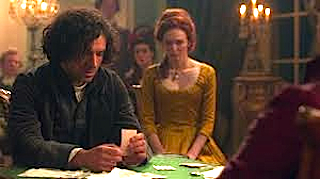
*Anything involving Demelza growing—as a woman, a wife, and a force of nature. Eleanor Tomlinson’s Demelza is softer, shyer, and a bit more vulnerable than her book-counterpart. I’ve worried about Ross riding roughshod over her, so I enjoyed her standing up to him at the Warleggan ball, after he left her alone to fend off all those amorous advances from rakes who thought she’d be easy pickings because of her origins. And I was glad that she was allowed to play an active role in Ross’s card game with Sanson, as she does in the book, rather than just look on in dismay and horror like Angharad Rees’s Demelza in the earlier series.
*Ross vs. Sanson. Effectively done, for the most part, with Ross appearing to become more drunk and incapable with every hand, only to drop the mask and expose Sanson’s cheating. I also enjoyed Robin Ellis’s return as Reverend Halse and his flashing a bit of Poldark temper, even while playing a character on the opposite end of the socio-political spectrum as Ross. Ellis still has remarkable screen presence, and—sorry, Mr. Turner—he will always be Ross to me. There was, however, one inexplicable omission in this whole sequence that merits inclusion in the WTF? section of this commentary.
*The prison sequences involving Jim Carter’s rescue were appropriately dark and grim. Some interesting/ironic detail was lacking, though. In the book, Jim was moved from Bodmin jail—the equivalent of county lock-up—to the much worse and more distant Launceston Prison because of the former was full of those newly arrested rioters. He also might have survived the fever, if it weren’t for a well-intentioned but foolish fellow inmate who bled him, which led to that gangrenous wound on his arm. I can see why they cut all this for simplicity’s sake, but I still regret the loss because it added more shadings to the situation.
*Ross’s drunken funk. In-canon and in-character. Sometimes I think the new series has been too keen on selling Ross as the brooding romantic hero and has ignored some of his darker, less admirable traits. But he can be a self-absorbed jerk at times, with a tendency to get lost—even wallow—in his own misery, bitterness, and moral outrage. Grief and anger over a friend/tenant, horribly dead before his time, is understandable, but it shouldn’t make you an asshole towards the ones you supposedly love, who still need your care and guidance. I appreciate that the episode didn’t soften or excuse Ross’s behavior. And Aidan Turner plays sodden-drunk almost too well.
*Verity’s advice to Ross—also from the book. It’s not clear in this series who is the elder, but in the books, Verity is two years senior to Francis and Ross, which gives her some influence over both, especially Ross. The incarnation of Verity has so often been depicted as dominated by the men in her family—particularly her selfish father—that it’s a welcome change to hear her give sound counsel to Ross about why he should attend the ball with his wife instead of brood at home with a bottle.
His Kingdom for a Box–or a Taller Wig!
The Bad
*George finally showed his partiality for Elizabeth, but it was a case of too little, too late, as the series had failed to capitalize on previous meetings between the two. “Too little” is also an unfortunately accurate descriptor of George himself, because even Heida Reed’s Elizabeth looks like she could beat him up with one hand tied behind her. He looks and sounds like a schoolboy trying to put the moves on his teacher, instead of a powerfully ambitious social climber enchanted by a friend’s gracious, blue-blooded wife. Zero physical presence. Which is a pity because there are other characters in the Poldark universe whom Jack Farthing could play convincingly—like Ross’s foppish cousin, St. John Peter or Monk Adderley, a slimy London rake with designs on Demelza’s virtue. At a pinch, he could swap parts with Kyle Soller and make a believable Francis, who is described as compact and fair. As it is, I try to imagine all the pivotal encounters between Ross and George throughout the whole Poldark Saga with Farthing in the role, and just . . . no.
Simply Resistible
*Keren the Brazen Slut. Even in the books, she’s on the make and hot for Dwight, but enough of her perspective is given to explain her actions. She’s stuck all day in a poorly constructed, dimly lit house, with an uneducated husband who works long hours and has no ambition to move up, and the women in the community neither like nor trust her. Here, she’s just a cheap little tramp, who throws herself off a ladder on purpose to get Dwight’s attention (or so I’ve heard from viewers who saw the uncut version of the episode) and then starts scheming to get into his house and his pants as quickly as possible. (In the book, her accident and injury were genuine, and we also got to see her reaction to the inside of Dwight’s house, which has carpets, comfortable furnishings, and books. Not a palace, but much nicer than her own living arrangements.) Even more disconcerting, Keren’s cheapness looks way too modern: all slouch and sulk, with unkempt hair and overly rouged lips. And a ton of bad attitude. You half-expect her to be chomping on a wad of gum and drawling, “Yeah?” and “What’s it to yer?” when anyone addresses her. She stands out like a contemporary mall rat in what’s supposed to be 18th-century Cornwall.
*This Dwight’s inability to dodge or see through someone as cheap and obvious as Keren makes me doubt his intelligence. Especially since he’s been aged up to be Ross’s near contemporary, instead of being five or six years younger. That makes “the stupid” a bit less forgivable and isn’t likely to help him in the next phase of the story.
Too Far or Not Far Enough?
The WTF?
*St. Elizabeth of the Perpetually Martyred Expression. I believe I mentioned at the outset that I’m not opposed to a more nuanced, sympathetic depiction of the character. However, just as it’s not necessary to make Francis more of a failure than he is in the books, it’s not necessary to make Elizabeth so much more saintly and put-upon than she is in the same source material. I don’t know which was more irritating—the Cinderella scenario of Elizabeth remaking an old gown to spare Francis’s pride or Elizabeth entering the card room to rebuke Francis and Ross for being neglectful husbands. Both, especially the latter, are out of character. As the blue-blooded daughter of an ancient family, Elizabeth would have the position and presence to carry off a twice (or more) worn gown—and she’d know it. She would also consider it beneath her dignity to express public disapproval of her husband’s conduct. In the book, it’s Margaret—the former prostitute who married into the gentry—who alerts Ross to the men flocking around Demelza while he gambles with Sanson.
*Apropos of which, how could the series cut the dramatic climax to the card game? Because Ross does more than expose Sanson’s cheating. Once extra cards are found in Sanson’s hand and in his waistcoat pockets, Ross drags him out of the card room, down the terrace steps, and throws him in the river—which is mostly mud, but still makes a definite statement and causes great embarrassment for the Warleggans! That excision completely stuns me. Why pass up the chance to depict such a dramatic moment when it’s right there in the book? Why cut off the potential for a more exciting pay-off? It’s reminiscent of the way they watered down Demelza’s father crashing the christening, and every bit as disappointing. Viewers not familiar with the books may have been satisfied with what was shown, but as a book reader, I maintain, “we wuz robbed!” and I hope future big moments don’t fizzle out like this.


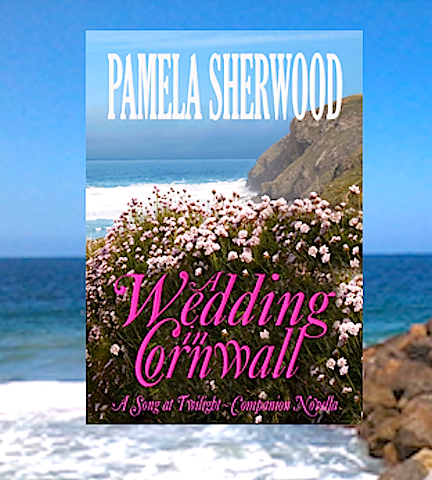

 On the up side, I can make the announcement that, barring further disaster (knocking repeatedly on wood), A Wedding In Cornwall–my companion novella to A Song At Twilight–will be released this month! I had a lot of fun revisiting Cornwall and writing about Sophie and Robin’s big day, as well as offering a hint about what lies in store for other characters.




 Blue Stockings & Crossed Genres