Whanne that Aprille . . .

Poets_cornerApril brings a number of things: warmer–if sometimes untrustworthy–weather, spring flowers, Easter (some years), income taxes (every year), and . . . National Poetry Month.

Poets’ Corner at Westminster Abbey. Geoffrey Chaucer was the first poet to be interred here, in the sixteenth century

Personally, I think poetry is worth celebrating any time, but I have no objection to there being an official month to recognize its awesomeness. I’ve never understood why some people dislike or seem afraid of poetry. Yes, some poems can be hackneyed, clichéd, obscure, or poorly constructed, but when written well, poetry can be sensual, passionate, witty, romantic, sharp, provocative, heartbreaking, hilarious, and eloquent as few other things can be.

My own love affair with poetry dates back to childhood, to Lewis Carroll, Edward Lear, and A. A. Milne. To whimsical poems that made me smile, to nonsensical poems that made me laugh. Later there were poems that moved, stirred, inspired, and sometimes inflamed me. I used to have a blog that I’d update every day in April with a poem. At the moment my life is a bit too busy to keep up that practice but for old times’ sake, I’m posting one today–a witty tongue-twister (just try to keep the words–and your face–straight, when reading this aloud!) by the one and only Ogden Nash!

The Private Dining Room

Miss Rafferty wore taffeta,
Miss Cavendish wore lavender.
We ate pickerel and mackerel
And other lavish provender,
Miss Cavendish was Lalage,
Miss Rafferty was Barbara.
We gobbled pickled mackerel
And broke the candelabara,
Miss Cavendish in lavender,
In taffeta, Miss Rafferty,
The girls in taffeta lavender,
And we, of course, in multi.

Miss Rafferty wore taffeta,
The taffeta was lavender,
Was lavend, lavender, lavenderest,
As the wine improved the provender.
Miss Cavendish wore lavender,
The lavender was taffeta.
We boggled mackled pickerel,
And bumpers did we quaffeta.
And Lalage wore lavender,
And lavender wore Barbara,
Rafferta taffeta Cavender lavender
Barbara abracadabra.

Miss Rafferty in taffeta
Grew definitely raffisher.
Miss Cavendish in lavender
Grew less and less stand-offisher.
With Lalage and Barbara
We grew a little pickereled,
We ordered Mumm and Roederer
Because the bubbles tickereled.
But lavender and taffeta
Were gone when we were soberer.
I haven’t thought in thirty years
Of Lalage and Barbara.

–Ogden Nash (1902-1971)

Do you have any favorite poems or favorite poets?

Happy Holidays, plus Book Giveaway!

600px-Bg-easter-eggs

To anyone reading this post, I wish you a happy holiday, whichever one you happen to observe. In our house it’s Easter, and while my family isn’t particularly religious, a celebration of spring and renewal after a long, cold winter seems apposite–and certainly welcome.

Bulgarian Orthodox Easter Eggs, photo by Ikonact

It’s been years since we dyed Easter eggs, probably because hard-boiled eggs, while pleasant in moderation, pall a bit after the first two or three. Likewise, it’s been a while since we had the Big Family Feed, probably because we already do that on Thanksgiving and Christmas, and it’s come to feel like too much work to do it three times a year. (We have taken to getting together for dessert, though.)

But there are other little rituals that retain their old charm and tend to be practiced more often than not. We used to watch the Astaire-Garland musical, Easter Parade, which was always running on some TV station or other on Easter Sunday. Some years, we’d follow it up with Harvey, another seasonal favorite. (Granted, Harvey’s actually a Pooka, but if the Easter Bunny existed, I’m sure they’d be well acquainted.)

A more recent ritual is purchasing some daffodils, which, for me, have become the quintessential spring flower. Trader Joe’s offers a bunch of 10 for about $1.30, a very reasonable price for a fistful of sunshine. Many of these bunches come with the buds still closed, so you have the pleasure of watching them unfurl before your eyes when you put them in water. The sight of them, golden and insouciant, can brighten any day.

John-Singer-Sargent-xx-Daffodils-in-a-Vase-xx-Fogg-Museum-of-Art

John Singer-Sargent, Daffodils in a Vase

Wordsworth’s “Daffodils” is justly famous, but today, I’m choosing the following poem by A. E. Housman, which captures the beauty and transience of the flower and the holiday with which it’s become so closely associated;

The Lent Lily

‘Tis spring; come out to ramble
The hilly brakes around,
For under thorn and bramble
About the hollow ground
The primroses are found.

And there’s the windflower chilly
With all the winds at play,
And there’s the Lenten lily
That has not long to stay
And dies on Easter day.

And since till girls go maying
You find the primrose still,
And find the windflower playing
With every wind at will,
But not the daffodil,

Bring baskets now, and sally
Upon the spring’s array,
And bear from hill and valley
The daffodil away
That dies on Easter day.

–Alfred Edward Housman

Do you have any seasonal/holiday rituals? I’ll be giving away a signed copy of Waltz with a Stranger to one commenter this week.

Spring is in the Air!

size1Some say that California has no true seasons. As a native Californian I’d dispute that, though I’ll concede that our seasons are less extreme than you’ll find on the East Coast or in the Midwest.  But even here, the transition between winter and spring is noticeable. The skies are more consistently blue, the air has a milder, softer quality, and lawns are starting to show colors beyond green and brown.

While I love many things about summer, I think spring might be my favorite season: the colors, the sunshine–gentler and less glaring than summer, the gayer, lighter clothes on the racks, the more varied fresh fruits and vegetables in the farmers’ markets. And something more . . . the general sense of movement, awakening, and new life that seems to come only with spring.

Fall and winter are seasons for drawing inward, for quiet reflection, for the comfort of familiar things and people. Spring coaxes you to open up again, to look around you with a fresh perspective, to sample new experiences and try different things. To unfurl yourself, in e.e.cummings’ words,  “as Spring opens ( touching skillfully,mysteriously)her first rose.” John_William_Waterhouse_-_The_Soul_of_the_Rose,_aka_My_Sweet_Rose

My sister recently informed me that celebrating spring is a worldwide practice. But whether the celebration’s called Beltane, May Day, Pascha, or Easter, rebirth and renewal are always cause for rejoicing.

What are your favorite things about spring?

Happy St. Patrick’s Day: Limerick Contest with Prize and Giveaway!

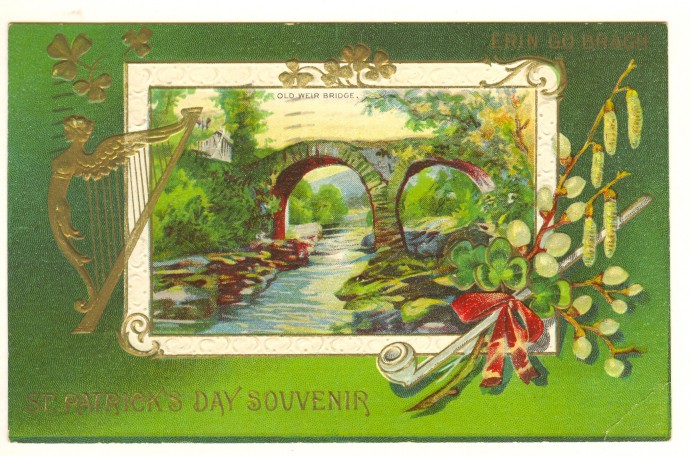
PostcardStPatricksDaySouvinir1912

Earlier this week I blogged over on Casablanca Authors about Ten (Non-Alcoholic) Things to Enjoy on St. Patrick’s Day.  However, I left one important thing off the list–even though there’s some debate over whether that thing is truly Irish or not! I’m talking about the limerick, one of the most popular and instantly recognizable forms of light verse. They can be witty, raunchy, contain clever epigrams, terrible puns, or blatant double-entendres.

Edward Lear, a Victorian poet, is among the best known perpetrator of limericks, though his tend to be fairly mild by today’s standards.

379px-Edward_Lear_drawing

There was an Old Man with a beard,
Who said, “It is just as I feared! —
Two Owls and a Hen,
Four Larks and a Wren,
Have all built their nests in my beard!”

(Lear, before he grew a truly terrifying beard himself in later life.)

The following examples of limericks aren’t attributed to any particular author, possibly with good reason!

There was an old man of Khartoum
Who kept a tame sheep in his room,
“To remind me,” he said,
“Of someone who’s dead,
But I never can recollect whom.”

There was a young lady of Ryde
Who ate some green apples and died.
The apples fermented
Inside the lamented,
And made cider inside her inside.

There once was a person from Lyme
Who married three wives at a time.
When asked, “Why a third?”
He replied, “One’s absurd,
And bigamy, sir, is a crime!”

I sat next to the Duchess at tea;
It was just as I feared it would be.
Her rumblings abdominal
Were simply phenomenal,
And everyone thought it was me!

This week, despite the spurious lineage of the limerick, I’m holding a limerick-writing contest. The first line is already provided. Entrants can choose from the following:

1. There was a young lady from Mayfair . . .

2. There once was a duke from St. James . . .

All entries must be turned in by midnight on Tuesday, March 19. I’ll be awarding a $25 Amazon gift card and a signed copy of my novel, Waltz with a Stranger, to the winner, to be determined by March 25.

Good luck to all participants–and have fun!

Tempus Fugit: The Even More Dubious Pleasures of Daylight Savings Time

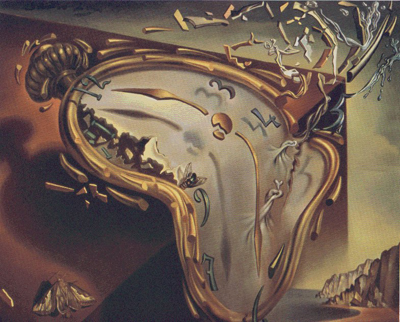
Dali21

One of Salvador Dali’s “Liquid Clocks”–and an all-too-apposite image of how I feel when we implement this time change!

Daylight Savings Time

In spring when maple buds are red,
We turn the clock an hour ahead;
Which means, each April that arrives,
We lose an hour out of our lives.

Who cares? When autumn birds in flocks
Fly southward, back we turn the clocks,
And so regain a lovely thing
That missing hour we lost in spring.

–Phyllis McGinley

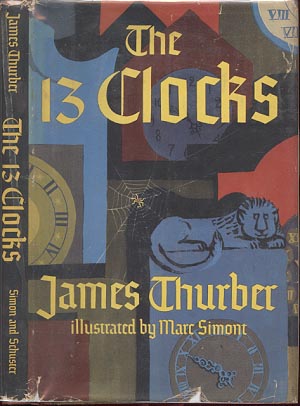
Sadly, I’ve never quite managed to be as philosophical as McGinley about Daylight Savings Time, which begins this weekend. In fact, to be brutally honest, I’ve never been a fan of DST and sometimes, I’ve flat out hated it. Especially when I was a kid and dragging myself out of bed on cold school mornings was already a challenge. Having to get up when it was pitch-black outside because some arbitrary force had decreed that it was an hour later than it had been the day before felt like cruel and unusual punishment. Even now, with my schooldays behind me, I still greet the advent of DST with a curled lip–and a snarl worthy of the Duke in The Thirteen Clocks.

The_13_Clocks_(Simont)

The clocks were dead, and in the end, brooding on it, the Duke decided that he had murdered time, slain it with his sword, and wiped his bloody blade upon its beard and left it lying there, bleeding hours and minutes , its springs uncoiled and sprawling, its pendulum disintegrating.

–James Thurber, The Thirteen Clocks

To make things even less pleasant, the change seems to be coming sooner every year. Where DST once took place at the end of April, by degrees it’s been creeping back. First to early April, than to late March, and now early March, a good two weeks before spring even begins! When the weather is still freezing, the mornings are still dark, and winter still lingers like a guest who’s worn out his welcome. (Even McGinley might have issues with that.) Artificially changing the time does nothing to counteract this seasonal malaise. If anything, I should think it would make it worse, increasing fatigue as our bodies try to adjust to this change and adding an element of stress as we struggle to compensate for that lost hour.

Spring forward, fall . . . flat on your face.

Granted, having no other choice, one eventually adjusts to the change in schedule. And maybe comes to appreciate in having a longer stretch of daylight, especially in the evenings. But the transition period can still be a major pain in the posterior, and the benefits of this temporal manipulation may be months in making themselves felt.

As someone who personally loves that extra hour, whether spent in sleeping, creating, or simply being, I bid it a fond farewell until the autumn. And hope fervently that no one ever comes up with the bright idea to have DST begin on January 1st!

Hope everyone out there weathers the time change successfully! This too shall pass.